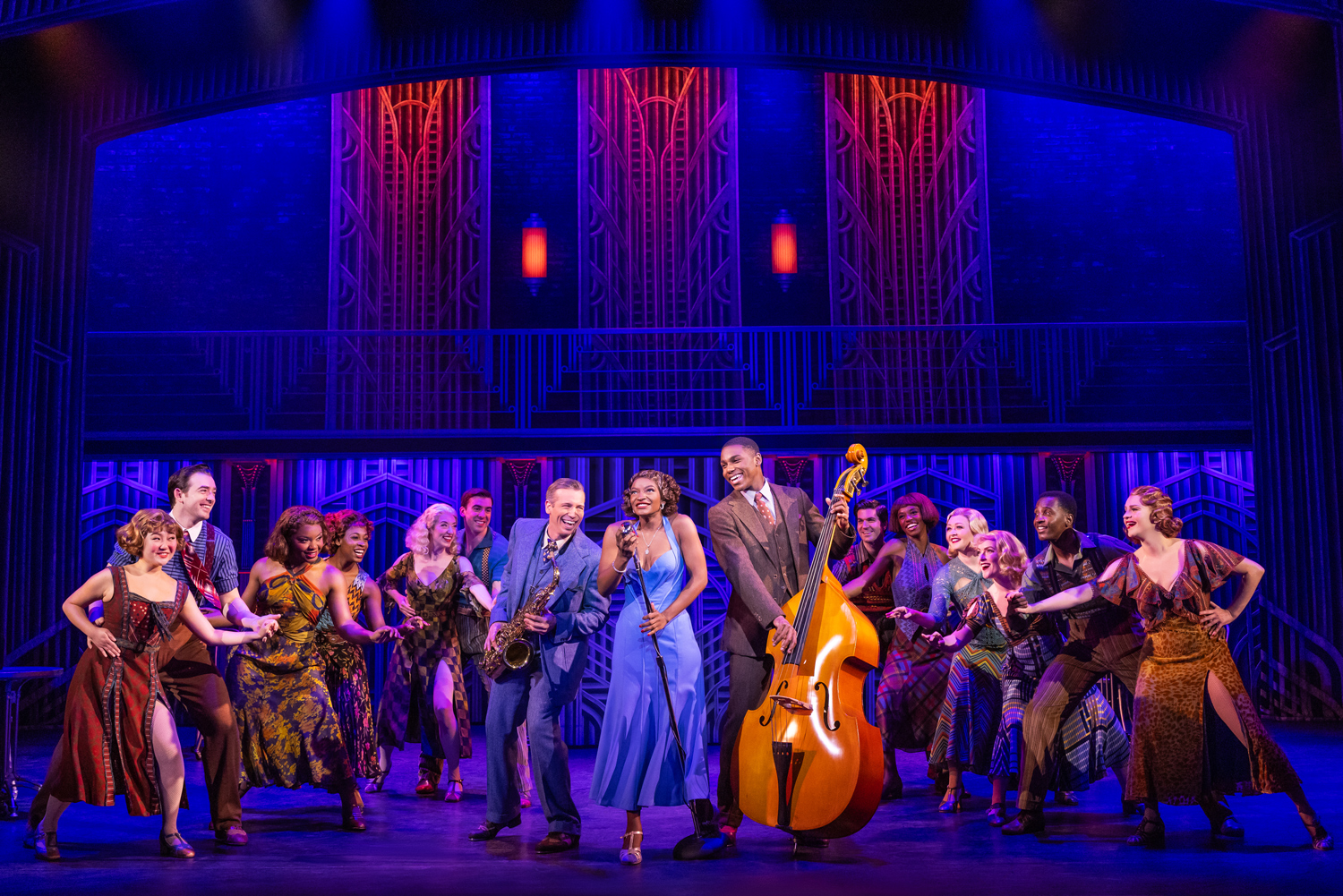
There are very few musicians who achieve the status of legend. It’s a term left only for those who have achieved greatness in their field, and left a lasting impression. It’s a title that is harder and harder to come by these days. It’s a title so highly regarded, that four legends made history on December 4, 1956. Carl Perkins, Jerry Lee Lewis, Elvis Presley, and Johnny Cash all convened on Sun Studio, the studio that gave all these greats their starts, and laid a few tracks.
There isn’t a whole lot of story to be concerned about with Million Dollar Quartet. Most of the exposition is merely there to explain who each person is, why they are there, and how they became so important in the American music cultural landscape. What little story is there ties the play together very well, but the real show comes from the displayed songs, which are closer to a rock concert than a stage play.
The story is based on fact, but much of it is fiction. Many of the songs presented in the show never show up on the actual Million Dollar Quartet recordings, and are there to lend familiarity to the audience. The show does cover actual moments in the original sessions, including a nice rendition of Chuck Berry’s “Brown Eyed Handsome Man”, and many others.
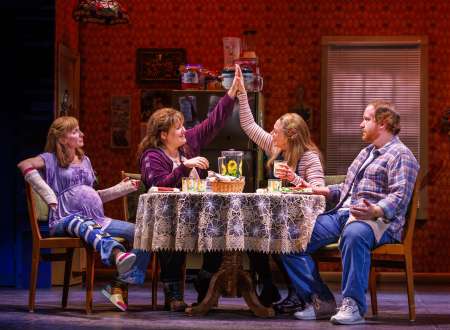
After seeing Next to Normal for the first time in 2011, there is no questions as to why it won 3 Tony Awards. Two of the three were for best original score and best orchestration, thanks in part to Mr. Tom Kitt. This raw and powerful rock musical is packed with music that completely takes over the audience, making it hard not to tap your foot along with each number. Kitt is also responsible for High Fidelity, a show which New Line revived from the dead on Broadway not only once, but for a second time in 2012 to rave reviews. This production of Next to Normal is no exception to their track record, full of moving performances and fantastic vocals.
What is normal? It is a question that is asked and answered subliminally throughout the show. As messed up as things may seem in your personal life, they may actually be closer to normal than you will ever know. Diana (Kimi Short) is the matriarch of what seems to be the “perfect loving family.” Her household is comprised of her husband Dan (Jeffrey M. Wright), daughter Natalie (Mary Beth Black) and son Gabe (Ryan Foizey). In the opening number ‘Just Another Day’ she sings, “so my son’s a little shit, my husband’s boring. And my daughter, though a genius, is a freak.” The beauty of the show comes from its truth, although often brutally honest, but nonetheless the truth. Sure, their family has problems. But who doesn’t? Yet something it also focuses on is mental illness, a subject that many have not been exposed to. Diana is on a strong regimen of drugs to suppress her bipolar disorder, something that is not easy on her family. As things get worse for Diana, her family finds it harder to coexist. The show takes her to multiple doctors, who prescribe her various treatments, while life continues to go on for her family around her. Read More [..]
After quickly becoming one of the most sought after Broadway shows to see, The Book of Mormon is finally going “door to door,” so-to-speak. In 2011 the brilliantly satirical musical, written by South Park creators Trey Parker and Matt Stone along with Robert Lopez (co-creator of Avenue Q), won 9 Tony Awards including best musical. It also broke the record for top ticket price, commanding $487.25 for a prime orchestra seat (purchased within 48 hours of the performance). So why is the hilarious, and often times offensive, comedy so great? Aside from the fantastic performances and catchy music, The Book of Mormon does exactly what creators Parker and Stone are best known for – never pulling any of their punches.
Find out how to get $25 tickets to see The Book of Mormon in St. Louis before each performance.
In case you haven’t figured it out yet, the subject of the musical is the Book of Mormon – or more specifically, the young Mormon missionaries who are sent to various locations around the world to spread its word. Elder Price (Mark Evans) has everything going for him, and can’t wait to start his mission. As missionaries are always teamed up in pairs, he hopes that he and another capable young Mormon will be sent to his dream location of Florida. But not unlike being picked last in kickball, the list of possible teammates is whittled down until he is matched with Elder Cunningham (Christopher John O’Neill) – who is a bit of an oddball, and probably the polar opposite of Price. And to add insult to injury, the two of them are sent to work in Uganda. Not only do they struggle to get along in a place where no locals have been converted by the missionaries before them, but they also have to deal with the war and fighting that is taking place around them.Finally! Symphony season is upon us. as such, I’d like to give a brief recap of last seasons finale…
Let me start by admitting that I am no veteran of attending symphony performances or even listening to classical composition. While I’ve always appreciated the form and style, I never caught the bug, so to speak, and so I went to this concert with very green, but open ears.
Upon arrival I read through the performance notes and saw that there had been an emergency stand in for the scheduled conductor, Rafael Fruhbeck de Burgos. Filling in on short notice was Toronto born conductor, Peter Oundjian. Peter began his relationship with the St. Louis Symphony in 1998 when he stepped in — again on short notice — and has been returning annually ever since. It was obvious there was a connection by observing how well he engaged with the players with such little ambivalence. Good and great conductors learn to mesh well with their orchestras and inspire their best performance or they fall from their perch or maestro
When I saw the movie adaptation “Chicago” almost a decade ago, I knew absolutely nothing about it the story, the music, the dancing, anything. And I was completely astounded. It quickly became one of my favorite films of all time. I loved the music. I loved the dancing. I loved the actors in the roles. I just thought it was a near flawless film. I couldn’t wait to see the stage version that it was based on. Several years later I did get to see it on the stage, and last night I got to see it once more. I must say, while the stage show is a different experience from the movie, the show does not disappoint.
“Chicago” tells the tale of Roxie Hart’s quick rise to fame. But why has Roxie become so famous? For killing a man of course! Is there really any other way to gain fame other than scandal. Velma Kelly is equally as notorious for the deaths she is accused of, but her star is waning as Roxie’s rises. Billy Flynn is the only man who can steer Roxie away from conviction, but can Roxie’s growing ego allow him to call all the shots, or will another little lady be filling headlines before Roxie makes it to the stand?