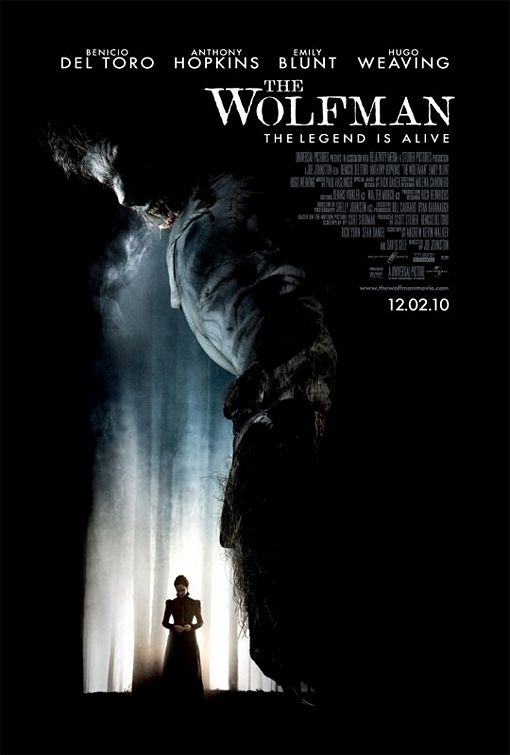
The filmmakers are wise to set the film in the past. Bringing the story into the present day would have forced the filmmakers to show the village being descended upon by media and “Bigfoot hunters.” Much of the tension comes from the panic of confused and uneducated townsfolk. But perhaps they set the film too far in the past. Surrounded by British actors (or close facsimiles), Del Toro’s very presence feels anachronistic. He’d have been better served if the film had been set in the 1930s. Distant enough to take much of modern technology out of the equation, but recent enough to account for his character’s propensity for present-day line readings.
The movie is on a constant, and fruitless, quest to have us sympathize with Lawrence Talbot. After all, he didn’t ask to be a Wolfman; he’s merely a victim of circumstance. In an effort to make him the “good guy” the townsfolk are portrayed as small-minded, fear mongering prisoners of their own superstitions and, by inference, deserving of their fate. However, there is one small problem with this plot device…um, they’re right. They’re not crazy. There really IS a wild beast that comes out every full moon to hunt and kill them like cattle.
In its second half, the film takes an odd diversion into anti-psychiatry as Talbot is placed in an asylum while the fledgling science attempts to find a rational explanation for his belief that he’s a lunar killing machine. Admittedly, the early days of psychiatry weren’t pretty. In fact they were often bleak and cruel. But the origins of medicine revolved around bleeding people with leeches, so perhaps we should cut them a little slack. At least these characters were attempting to apply science and objectivity, however rudimentary, to the situation. It seems better than the film’s competing theory, which essentially boils down to “Gypsies did it.”
But how’s the Woflman stuff, right? That’s the question you’re asking. It’s a decidedly retro take on things. Recent werewolves are more akin to giant dogs. This Wolfman is like that of old; he walks upright (except when he runs) and his clothes are torn but still in place. The biggest change is in the amount of gore. When this Wolfman kills you, believe me, you know you’ve been “kilt.” Limbs go flying to-and-fro, heads get ripped off with one swat, intestines are on display. And, honestly, these are the best parts of the film. The Wolfman finds its footing only when it kicks into blood-fueled killing-frenzy mode. The rest of the time, it’s something of a snooze.
On a scale of 1 to 10, with 10 being The Wolf Man and 1 being Teen Wolf Too, The Wolfman gets a 5.
Clue, originally known as Cluedo, was created in 1943 by British board game designer Anthony…
Inside a WWE ring, Jacob Fatu looks like a man who could come unhinged at…
Brad Pitt and director David Ayer team up once again in Heart of the Beast,…
Raquel Rodriguez has spent years establishing herself as one of the most powerful women in…
Sports fans love a good comeback story. By now I’ve learned that life hits you…
With Special Correspondent Jon Wehrenberg In a sea of yellow and in front of a…