
 By
By Benny Safdie’s The Smashing Machine isn’t a film you watch lightly. It’s raw, relentless, and often painfully intimate. It is a portrait of violence, addiction, and self-destruction captured with the immediacy of a documentary. Yet within its grit lies a breakthrough: the movie that may finally establish Dwayne Johnson as more than a global box-office draw. Here, Johnson sheds “The Rock” persona once and for all.
Make no mistake, this is Johnson like we’ve never seen him.
For decades, Dwayne Johnson has carried the weight of his own myth. As “The Rock” in WWE, as the action franchise anchor in Fast & Furious and Jumanji, and as a larger-than-life public figure, he’s leaned on charisma and spectacle. But in The Smashing Machine, Johnson disappears into the role of Mark Kerr, a man who outwardly seems like the ultimate gladiator but inside is broken by painkillers, toxic love, and the emptiness of chasing fleeting glory.
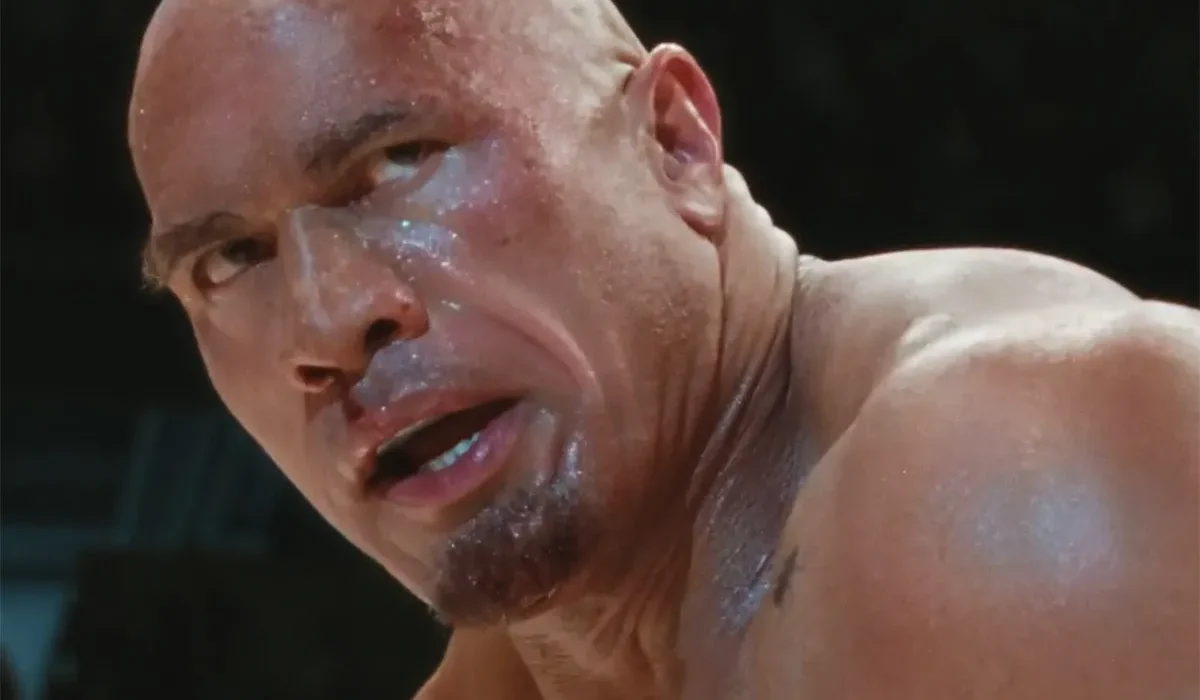
Johnson doesn’t wink at the camera. There are no catchphrases, no raised eyebrows. Instead, there’s slurred speech after too many pills, the glassy-eyed look of a man who can’t tell if the roar of a Japanese stadium is keeping him alive or killing him, and the quiet despair of someone who no longer knows how to live outside the cage. It’s a transformative performance and proof that Johnson can stand shoulder to shoulder with the best dramatic actors of his generation.
Along with a career-defining performance from Johnson, we get a standout performance from Emily Blunt and newcomer to the big screen, MMA champion, Ryan Bader.
Emily Blunt brings as much fire to the film as Johnson does. As Dawn Staples, Kerr’s girlfriend and later wife, she embodies the messy contradictions of a woman drawn to fame, luxury, and the gravitational pull of a man who is constantly on the edge of collapse. Their relationship scenes are harrowing, tender one moment, toxic the next. Blunt avoids caricature and instead gives us a character who is complicit and sympathetic, selfish and wounded, all at once.
Then there’s Ryan Bader, the real-life MMA champion whose presence anchors the film’s fight sequences with authenticity. He never feels like a stunt cast athlete. Instead, his scenes breathe the unvarnished reality of fight culture, the locker room banter, the comradery, and the violence that follows. His inclusion makes Safdie’s film feel all the more convincing.
Benny Safdie directs with a documentary-maker’s eye. Working with cinematographer Maceo Bishop, he refuses to polish the world of MMA into Hollywood sheen. The fights are brutal, repetitive, and often difficult to watch, and that’s the point. Safdie shows the violence without stylization, letting the dull thud of fist-to-flesh linger. Between matches, the handheld camera finds its way into the quiet moments of addiction: Kerr slumped on a couch, Dawn trying and failing to bridge the emotional gap, pills being popped in silence.
This is no inspirational sports story. It is a film about what happens when glory and self-destruction intertwine, about a man whose dragon tattoo on one shoulder masks the two tiny insects on the other. It’s about power and fragility permanently etched side by side.
As someone who grew up watching MMA in its early stages and has covered it as a sports writer, I know the allure of combat sports without ever fully understanding it. I’ve covered sports as a writer, I’ve been knocked around while covering from the sidelines, and I know the dull ache of injuries that don’t fade. Watching The Smashing Machine, I couldn’t help but think about the price of being hit over and over, of waking up one day and realizing your body has become both weapon and prison.
The film raises the ultimate question: was it worth it? For Kerr, the victories in Brazil, the Pride tournaments in Japan, and the adoration of tens of thousands must have felt intoxicating. But by the end, when addiction, pain, and fractured relationships pile up, the glory seems like a cruel mirage. Safdie doesn’t answer the question for us, rather, he lets it hang in the air, unresolved, as the credits roll.
The Smashing Machine is as much a cautionary tale as it is a character study. It’s about a man who smashed others until he smashed himself, and about the culture that cheered until it turned away. Dwayne Johnson delivers a career-defining performance, Emily Blunt matches him note for note, and Ryan Bader grounds the world with realism.
It is not an easy film to watch, nor is it designed to be. But it’s an unforgettable one.
The Smashing Machine is the kind of film that bruises long after the final bell.
The Smashing Machine gets a B+.