
 By
By Sports fans love a good comeback story. By now I’ve learned that life hits you harder than any opponent can, and I admire anyone who is willing to get back up after being knocked down. So, when I read Scott Spiezio’s story, I knew I had to talk to the former St. Louis Cardinals star.
Scott Spiezio knows what it feels like to reach the top of the baseball world.
Twice.
He knows the roar of a World Series crowd, the weight of a championship ring and the feeling of delivering when a season is hanging in the balance.
But when Spiezio looks back at his two World Series championships with the Anaheim Angels in 2002 and the St. Louis Cardinals four years later, he remembers two dramatically different versions of himself.
The first championship was almost everything he could have imagined.
“The Angels was incredibly special,” Spiezio said. “I played every game, every at-bat.”
Spiezio drove in 19 runs during the 2002 postseason, then a record, and delivered one of the defining swings of the Angels’ championship run. Nearly 50 family members and friends were there to share the experience.
Four years later, Spiezio celebrated another championship in St. Louis.
This time, the celebration was complicated.
By then, his life away from the field had begun moving in a much different direction. Spiezio said he began drinking after an injury while playing in Seattle in 2004. Although he was able to refocus during the 2006 season, his relationship with his parents had deteriorated because of choices he was making.
He continued drinking and eventually began using drugs.
“It was a really exciting time, but it was also a sad time,” Spiezio said of the Cardinals’ championship season. “I really wanted my family and my parents to be there, and it just didn’t happen.”
Today, Spiezio can look at those experiences from a perspective that reaches well beyond baseball.
“There’s more to life than baseball and what you do,” he said.
For much of his life, baseball was understandably at the center of Spiezio’s identity. His father, Ed, played in the major leagues and appeared in three World Series with the Cardinals.
Scott followed him to the majors and carved out his own 12-year career.
But some of the most important lessons came after baseball became secondary.
“Don’t find your identity in what you do,” Spiezio said. “Me, as a Christian, that’s where I find my identity through Christ and trying to help others and find my true purpose, which is sharing my story and giving people hope.”
Of all Spiezio accomplished on a baseball field, one moment remains permanently attached to his name.
Game 6 of the 2002 World Series.
The Angels trailed the San Francisco Giants 5-0 in the seventh inning and were facing elimination. Fans in Anaheim were already heading toward the exits.
Spiezio stepped to the plate with two runners aboard.
Yet in some ways, he had been preparing for that at-bat since childhood.
His father regularly created pressure situations during their backyard hitting sessions. They would finish with an imaginary scenario: full count, two outs, bases loaded, down by one in the bottom of the ninth inning of Game 7 of the World Series.
His mother would shag baseballs.
“Do it for the ring, Scott,” she would tell him.
His father also taught him visualization, encouraging him to picture himself succeeding in baseball’s biggest situations.
“When I got in those situations, I felt like I had already been there a million times,” Spiezio said.
Now the situation wasn’t imaginary.
Spiezio had already driven in 16 runs during the postseason when he came to the plate in the seventh. Giants manager Dusty Baker removed starting pitcher Russ Ortiz and handed him the game ball before Ortiz walked toward the dugout.
Spiezio noticed.
“To me, I thought that he thought that the game was over, that he gave him a souvenir,” Spiezio recalled. “And it kind of pissed me off.”
Right-hander Félix Rodríguez entered the game.
Spiezio fell behind 1-2 before battling through an eight-pitch at-bat and working the count full.
Then Rodríguez came inside.
Spiezio connected.
He knew he had hit the ball on the barrel, but he wasn’t sure it had enough distance.
“I basically was praying on the way down to first, like, ‘God, please let this go out,’” he said.
It did.
The three-run homer cut the deficit to 5-3 and transformed the atmosphere inside the stadium.
Spiezio pumped his fist.
“The only time in my life I pimped a home run,” he said.
Suddenly, those childhood backyard scenarios came rushing back.
“I started reliving those moments in the backyard with my parents,” Spiezio said.
The Angels completed the comeback, winning 6-5 before defeating the Giants the following night to capture the franchise’s first World Series championship.
Four years later, Spiezio’s baseball journey took him somewhere that carried special meaning for his family.
St. Louis.
At the time, however, he wasn’t sure his major-league career would continue at all.
After being released by Seattle, Spiezio said he was depressed and drinking heavily.
Then one morning he heard something hitting an upstairs window.
A cardinal was outside.
Minutes later, his agent called.
The Cardinals wanted to invite him to spring training.
“This is unbelievable,” Spiezio remembered thinking.
He dyed his facial hair red, despite his agent warning him that it might not play well in conservative St. Louis, and arrived at camp expecting to receive a high spring-training uniform number.
Instead, he looked inside his locker.
No. 26.
His father’s old Cardinals number.
“I started tearing up,” Spiezio said.
He immediately became convinced there was something special about the team around him.
“We’re going to win the World Series,” he began telling teammates.
Their response?
“How about you make the team first?”
Spiezio did.
And he was right.
The Cardinals won the 2006 World Series.
Yet one thing was missing.
His father.
After the championship, the organization found a way to change that.
When the Cardinals received their World Series rings, Ed Spiezio was brought back to Busch Stadium as a surprise presenter for his son.
Scott didn’t know his father was there.
When he turned around and saw him wearing his Cardinals jersey, the emotions took over.
“I started bawling,” Spiezio said.
He calls it his “prodigal son moment.”
Even after two World Series championships and countless memorable moments, that remains the scene he would choose if given five minutes to relive anything from his career.
“The championships are unbelievable,” Spiezio said. “You can never take those away from the team and the organization, especially the fans. But that moment, for me, was probably more important than any other moment in my career.”
Spiezio’s story, however, doesn’t end with championship rings.
He has chosen to publicly confront the parts of his life that are far less comfortable to discuss.
His struggles with addiction, alcoholism, depression and anxiety became central to the story he wanted to tell through his book and documentary.
Writing about those experiences wasn’t easy.
Spiezio said he spent time searching for the right person to help him tell the story. Even eventual co-author Leslie Butcher initially declined because of the commitment involved.
After participating in the documentary project, however, she reconsidered.
The decision was made to tell the story without hiding its darkest moments.
“We’re going to let it all fly,” Spiezio said.
He knew a book filled solely with baseball stories would have been easier.
There were plenty available.
Home runs. Grand slams. World Series championships. Stories about sharing clubhouses with some of the greatest players of his generation.
But that wasn’t the book he believed he needed to write.
“It would have been much easier to write a book about home runs and grand slams and great plays,” Spiezio said. “But I knew that this was my purpose and I needed to get this story out there.”
That meant being honest about addiction.
Spiezio admits there was a time when he had little empathy for people experiencing the same struggles he would eventually face.
Nobody in his immediate family had dealt with addiction or alcoholism, he said, and his parents barely drank.
He once viewed people struggling with addiction, depression or anxiety as weak. He also considered counseling, Alcoholics Anonymous and rehabilitation signs of weakness.
Then his own life changed.
“I want people to realize that this is a real thing,” Spiezio said. “It can hit anybody, even somebody like me that thought it wasn’t real.”
His perspective is now radically different.
“Now I have incredible empathy for people dealing with it,” he said.
That empathy is one reason Spiezio believes it is important to describe the ugly parts of his experience honestly.
He wants people battling addiction to recognize something authentic in his story. He also wants their families to better understand what their loved ones may be experiencing.
From the outside, Spiezio’s life once appeared to contain everything a baseball player could want.
Inside, things were much different.
His message now is that others experiencing similar struggles are not alone and that life can exist on the other side of them.
Spiezio played alongside some of baseball’s biggest names.
He remembers Albert Pujols as one of the hardest workers he encountered, mentally and physically, and praised his leadership and defensive development. He played with all three Molina brothers and described them as some of the best catchers he’d ever seen.
The list of teammates Spiezio rattles off reads like a snapshot of baseball history: Mark McGwire, Rickey Henderson, Ichiro Suzuki, Edgar Martinez, Jason Giambi and others.
He experienced moments most baseball players can only imagine.
But today, the moments that mean the most don’t necessarily happen inside stadiums.
They arrive in text messages.
Someone tells him they reached one year of sobriety.
Someone says hearing Spiezio’s cautionary story helped save a marriage.
Others tell him his story helped save their lives.
Those messages have changed what a “big moment” means to him.
“When I hit those home runs and huge hits in key situations, there’s nothing like that feeling,” Spiezio said.
But helping another person?
That is different.
“To possibly play a role in saving somebody’s life … there’s nothing like it,” he said.
Spiezio once created memories for baseball fans.
Now, he believes his experiences, the championships and failures, the home runs and addiction, the celebrations and pain, can serve another purpose.
“I realized that this was all my purpose all along,” he said.
More than two decades have passed since Spiezio stood at the plate in Anaheim with his team’s season slipping away.
Back then, his job was simple.
Get something started.
One swing changed a World Series.
Today, Spiezio is hoping his story can do something much bigger.
For someone who needs to hear it, maybe it can get something started again.
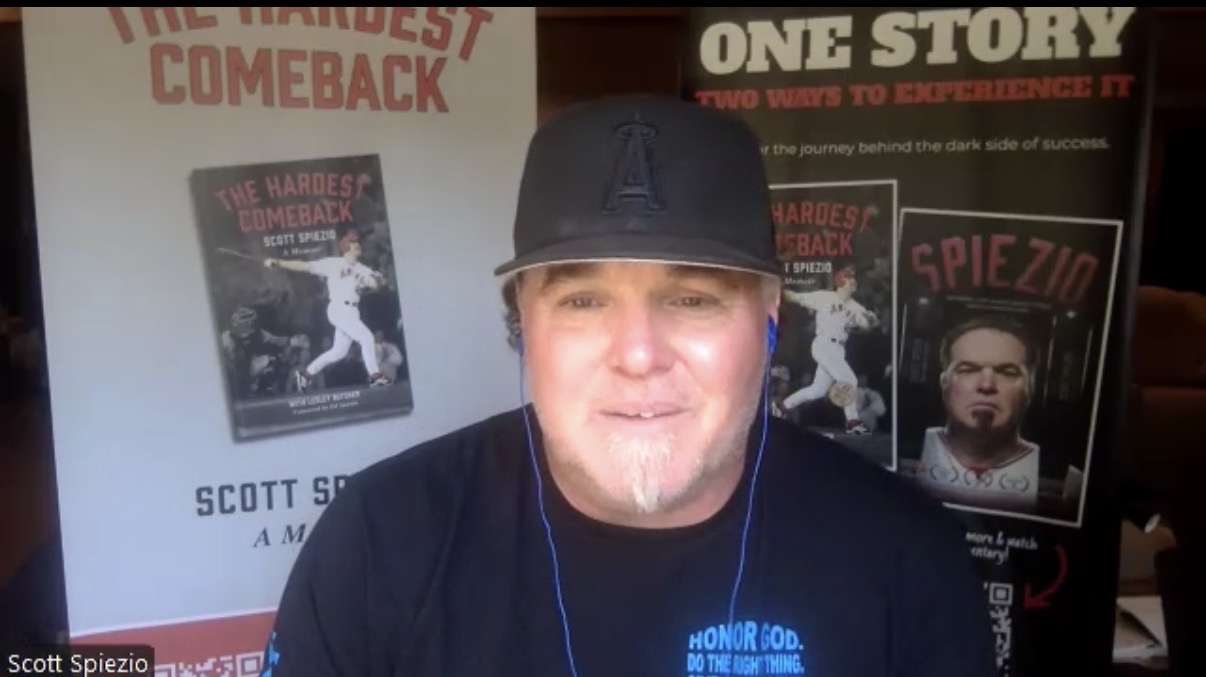
To pick up a copy of Spiezio’s book and read more about his story, visit his website www.scottspiezio.com.
Also, check out the trailer of the new documentary, SPIEZIO, below.